• Skip to primary navigation
  • Skip to main content
  • Skip to primary sidebar
  • Skip to footer
  • Facebook
  • Instagram
  • Français
  • English
Simply Savoie Logo

Simply Savoie

Guided walking – snowshoeing – via ferrata in the French Alps with Mark Tennent

  • Home
  • Snowshoe
    • Snowshoe Walking in the Three Valleys
      • Guided Snowshoe Walks Courchevel
      • Guided Snowshoe Walks in Meribel
    • Snowshoe Walking in the Vanoise
    • Guided Snowshoe Weekends in the Vanoise
    • Snowshoe Walking in the Beaufortain
    • Guided Snowshoe Weekend in the Beaufortain
    • Snowshoe Traverse of the Beaufortain
    • Snowshoe Traverse of the Chartreuse
    • Snowshoe Walking in the Haute Maurienne
  • Avalanche Courses
    • Introductory Avalanche Search and Rescue Training Course
    • Intermediate Avalanche Search and Rescue Training Course
    • Avalanche Training Essentials Course
    • Avalanche Awareness Talks
  • Via Ferrata & Rock Climbing
    • Rock Climbing
    • Guided Via Ferrata Weekends
    • Guided Via Ferrata Weeks
    • Via Ferrata in the Hautes-Alpes
    • Via Ferrata holiday in the South of France
  • Walking
    • Centre Based
      • Walking in the Maurienne – Vanoise
      • Walking in the Vanoise
      • Walking in the Beaufortain
      • Walking in the Aravis and Bauges
      • Photography and Walking in the French Alps
    • Trekking
      • Tour of the Vanoise
      • Tour du Mont Blanc
      • The Haute Route – Chamonix to Zermatt
      • The Tour of the Beaufortain
      • Corsica – GR20
      • Tour of the Ecrins
      • Tour of the Queyras
      • 3000m Summits Week
      • The Verdon Gorge & the Haute Provence
  • Custom Guiding
  • About
    • Mark’s Blog
  • Contact

Mark

How are Via Ferrata graded in France?

In France via ferrata are graded using the well-established names used for alpine mountaineering. It is this grade that you will encounter on the information panels and in the local tourist offices.

So the grades (?cotations?) in use in France, in rising order of difficulty, are:

  • F (Facile) ? easy
  • PD (Peu Difficile) ? literally a little bit difficult
  • AD (Assez Difficle) ? literally difficult enough
  • D (Difficile) ? difficult
  • TD (Tres Difficile) ? very difficult
  • ED (Extrement Difficile) ? extremely difficult

These grades may be modified with a ?+? or a ?-? to indicate that they are at the top or bottom end of the grade respectively.

As with all grading systems there is a large degree of subjectivity. What one person may find D another may find TD and vice versa. However for long established routes the grades will be an overall consensus that will tend to be reasonably accurate. It gives some food for debate with friends!

You should note that there is no correlation between a via ferrata graded at TD (Tr?s Difficile) and an alpine mountaineering route of the same grade!

Via Ferrata Location

It’s also worth bearing in mind that some via ferrata are located in valleys whilst some are located high in the mountains.

Weather conditions can change rapidly and old snow fields (neve) may be encountered in early summer.

Via Ferrata for Children

Nant de Rossane Via Ferrata - Bauges - Alps - France
My youngest daughter enjoying her first via ferrata

Some via ferrata are especially adapted for children by the making sure that the bars, cables and other equipment are closer together for children and small adults. This may be indicated in descriptions.

Physical Difficulty and Exposure

The grade takes into account the physical difficulty, duration and ?exposure? of the route. Some via ferrata may have ?athletic? sections where you may need good arm and upper body strength. The length of such sections and how many there make up the physical difficulty element.

Via ferrata that are high above the ground give a feeling of ?exposure?. People’s ability to cope with heights varies but is usually related to how frequently you are high above the ground or on narrow ridges with large drops on either side.

Via Ferrata Guidebooks

The Cicerone guide, produced in the UK, uses a ?proprietary? grading system that makes it hard to relate to how via ferrata are graded in France.

Links

Check out my via ferrata holidays and guiding services
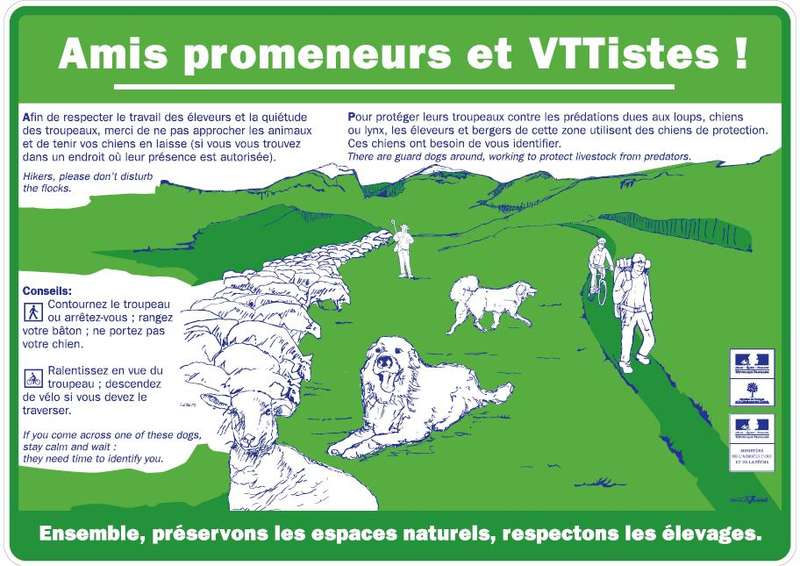

“Patou” – Guard Dogs in the French Mountains

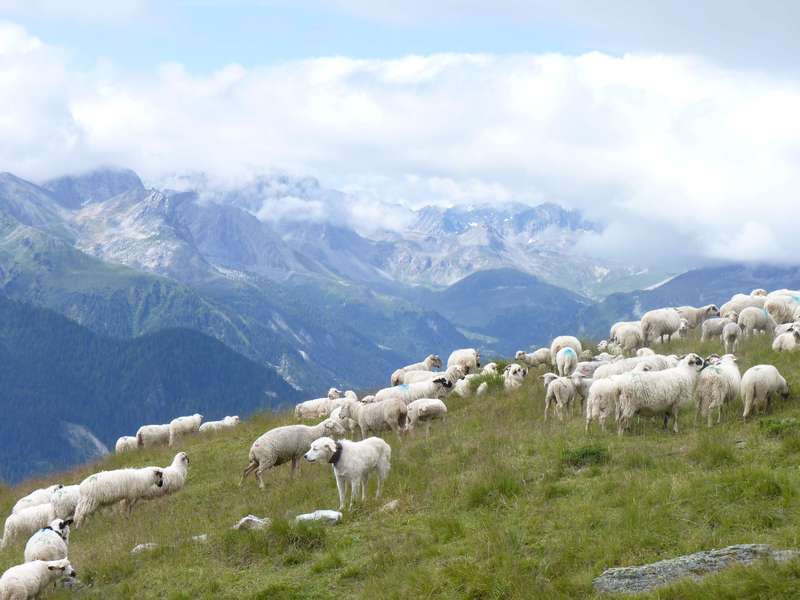
Walking in the French Alps or the Pyrenees, you will frequently come across herds of cows, sheep or goats. The sound of the bells tinkling is all part of the Alps. Maybe you will see a shepherd with them. The scene is all part of the timeless traditions in the mountains.

You are walking along a path enjoying being out in the mountains. Up ahead there’s a flock of sheep. If the terrain allows you to give the flock a wide berth.

As you approach you suddenly hear barking and a large dog running towards you.

How should you react? Stop!

The “Patou” thinks that you are a potential threat to the flock. It coming to find out. They may come quite close (5 to 10 metres) and bark furiously.

Do’s

  • Stop! Stand still!
  • Keep your arms down by your side.
  • Speak calmly to the dog(s).
  • Stay calm & wait! (calm at least outwardly).
  • Move slowly away from the dog and the flock. If the dog starts barking again stop again!
  • If the flock is blocking the path go around (if the terrain allows) rather than ?force? your way through the middle.

Don’ts

  • Don’t run! The patou may well chase you and it’s faster than you.
  • Don’t wave walking or trekking poles around, this will be seen as a threat.
  • Don’t throw stones at the dog(s).
  • Don’t use pepper spray or similar products.
  • Avoid making direct eye contact with the dog – again this is seen as a “challenge”.
  • The dog may take a several minutes to decide that you are not a threat. It will gradually calm down and may then wander back towards the flock.
The right way to react to the “Patou” – video: Parc National des Cevennes

What are these dogs?

In the Alps they are known as ?Patou? however they are perhaps more commonly known as Pyrenean Mountain Dogs.

They are large, 65 – 85 cm at the shoulder, with a long white coat. They make good guard dogs as they are loyal to what they see as their ?family?. The dogs are brought up as puppies with the flocks and then come to see them as part of their family. They are very protective.

Why are these dogs there?

Patou - Guard Dog in the French Mountains - Alps - France
Patou – Guard Dog in the French Mountains – Alps – France

To protect flocks from predators. In particular the increasing population of wolves. In the Pyrenees they also protect from bears.

A Patou among a flock of sheep
A Patou with a flock of sheep in the Vanoise, Alps, France

Farmers use guard dogs, patou. These dogs stay out on the mountains with their flocks day and night. Their use is largely due to the increasing population of wolves. There are regular wolf attacks reported in the local papers and farmers are understandably taking measures to protect their flocks and their livelihoods. One of the ways is through the use of patou. Wolves have spread over from Italy in particular. The wolf is a protected species under the Berne convention and to kill them needs an authorisation from the local pr?fet.

French Regulations for Leading Groups in the Mountains – Code de Sport

Code du sport
  • Partie l?gislative
    • LIVRE II : ACTEURS DU SPORT
      • TITRE Ier : FORMATION ET ENSEIGNEMENT
        • Chapitre II : Enseignement du sport contre r?mun?ration
          • Section 1 : Obligation de qualification

Article L212-1

I.-Seuls peuvent, contre r?mun?ration, enseigner, animer ou encadrer une activit? physique ou sportive ou entra?ner ses pratiquants, ? titre d’occupation principale ou secondaire, de fa?on habituelle, saisonni?re ou occasionnelle, sous r?serve des dispositions du quatri?me alin?a du pr?sent article et de l’article L. 212-2 du pr?sent code, les titulaires d’un dipl?me, titre ? finalit? professionnelle ou certificat de qualification :

1? Garantissant la comp?tence de son titulaire en mati?re de s?curit? des pratiquants et des tiers dans l’activit? consid?r?e ;

2? Et enregistr? au r?pertoire national des certifications professionnelles dans les conditions pr?vues au II de l’article L. 335-6 du code de l’?ducation.

Peuvent ?galement exercer contre r?mun?ration les fonctions mentionn?es au premier alin?a ci-dessus les personnes en cours de formation pour la pr?paration ? un dipl?me, titre ? finalit? professionnelle ou certificat de qualification conforme aux prescriptions des 1? et 2? ci-dessus, dans les conditions pr?vues par le r?glement de ce dipl?me, titre ou certificat.

II.-Le dipl?me mentionn? au I peut ?tre un dipl?me ?tranger admis en ?quivalence.

III.-Les dispositions du I s’appliquent ? compter de l’inscription des dipl?mes, titres ? finalit? professionnelle ou certificats de qualification sur la liste des dipl?mes, titres ? finalit? professionnelle ou certificats de qualification r?pondant aux conditions pr?vues aux paragraphes I et II, au fur et ? mesure de cette inscription.

IV.-Les personnes qui auront acquis, dans la p?riode pr?c?dant l’inscription mentionn?e au III et conform?ment aux dispositions l?gislatives en vigueur, le droit d’exercer contre r?mun?ration une des fonctions mentionn?es au I conservent ce droit.

V.-Un d?cret en Conseil d’Etat d?termine les conditions d’application du pr?sent article. Il fixe notamment les modalit?s selon lesquelles est ?tablie la liste mentionn?e au III.

Flowers of the French Alps

The flowers in the French Alps are a great reason to walk in the mountains.  This weekend we went walking in the Beaufortain.   The hillsides were carpeted with the many flowers of the French Alps.  We saw Gentianes, Yellow Pasque Flowers (Pulsatilla alpina apiifolia) and Alpine Pansy (Viola calcarata). Our walk started near the Lac de St Guerin (c. 1500m) and from here we climbed to the ridge (c. 2000m) that also overlooks the Lac de Roselend.  Between Beaufort and Areches we saw several herds of Tarine cows enjoying luxuriant meadows. The milk goes to produce dairy products; particularly the cheeses for which the area is famous like Beaufort.  Steep alpine pastures don’t lend themselves to intensive agriculture. They have been saved from the quest for ever increased yields by the use of chemical fertilisers, weed killers and insecticides. This has maintained the great diversity of plants and flowers.

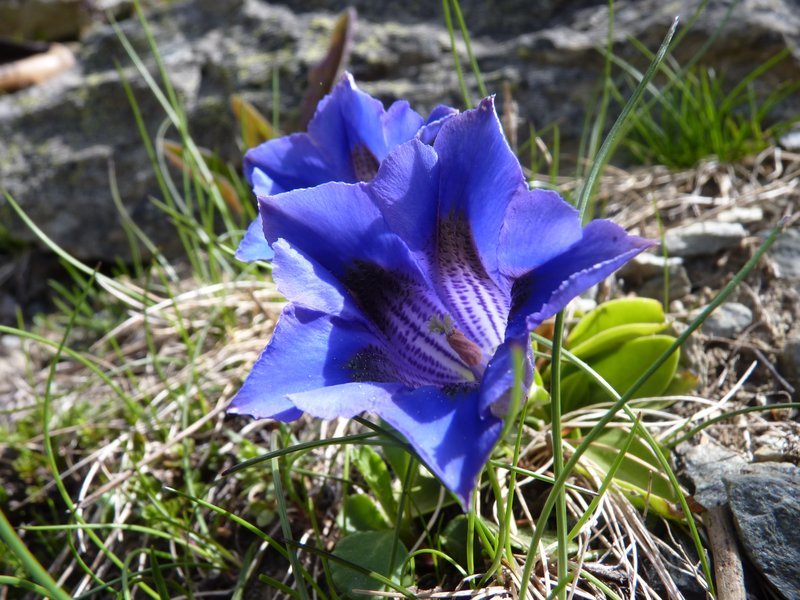
A Gentiane in the French Alps

Alpine plants have adapted themselves to the harsh environment. With increasing altitude the weather becomes more extreme. Large variations of temperature, not only through the year but also between day and night. At higher elevations ultra-violet light becomes more intense. Wind speeds increase, so plants are smaller and grow close to the ground. Lack of water can be an issue so plants create their own micro-climates like the Androsace des Alpes (Androsace alpina). The growing season is much shorter. This is not only due to temperatures but also the snow that covers the mountains for around 5 months of the year.

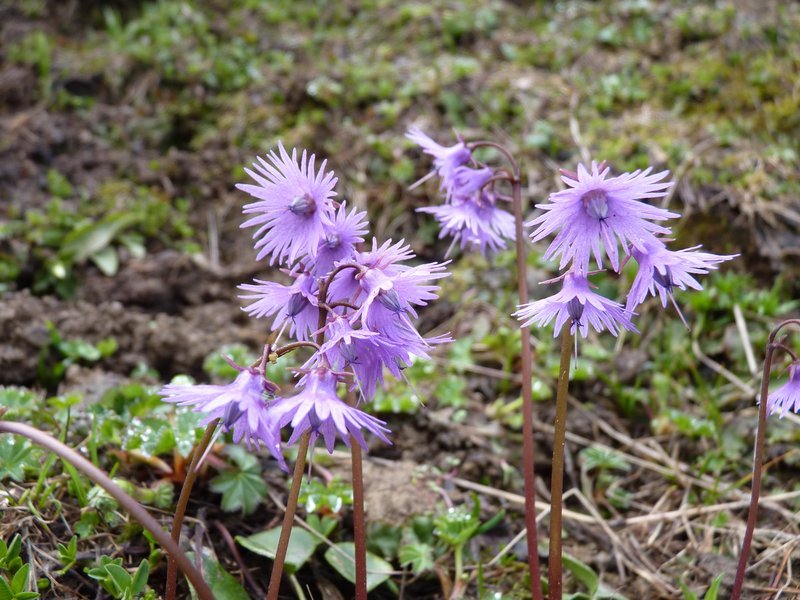
Depending on the altitude the mountains of the Alps are covered in deep snow from late November to mid-April / May. As the snow recedes flowers are quick to emerge from their winter hibernation. Some of the first flowers to appear are Spring Crocuses (Crocus albiflorus) and Soldanelle (Soldanella alpina). We were treated to amazing quantities of Gentiane acaule (Gentiana acaulis). Their stunning blue a wonder of nature contrasting beautifully with the green, browns and greys of the hillside.

Soldanellet des Alpes
Soldanelle des Alpes – Alps – France

When’s the best time for flowers in the French Alps?

People often ask, when is the best time of year to enjoy Alpine flowers in bloom? June is probably the ideal month but the first half of July is not too late. Clearly the flowers you will see depends on the altitude, the soil, rock type, the aspect, etc. Some plants love boggy, acidic soil whilst others thrive on rocky ground. So, if you’re looking for a particular plant, it helps to know their preferred terrain.

The Edelweiss (Leontopodium alpinum) is synonymous with the Alps. It typically grows between 1800 and 3100m. I’ve found edelweiss whilst walking the Haute Route from Chamonix to Zermatt, in the Vanoise National Park and in the Queyras. I regularly walk the Tour des Glaciers de la Vanoise and know spots where I can almost guarantee to find edelweiss. Those familiar with the Alps will know of drinks like genepy (Artemisia) made from the plant that grows on old glacial moraines. The Yellow Gentian (Gentiana lutea) looks nothing like the blue gentians but is a tall stemmed plant with yellow flowers. It’s roots are used to make Gentiane Liqueur. The famous Chartreuse liqueur is flavoured with a variety of wild plants whose recipe is a closely guarded secret by the monks of the Monastery of the Grande Chartreuse.

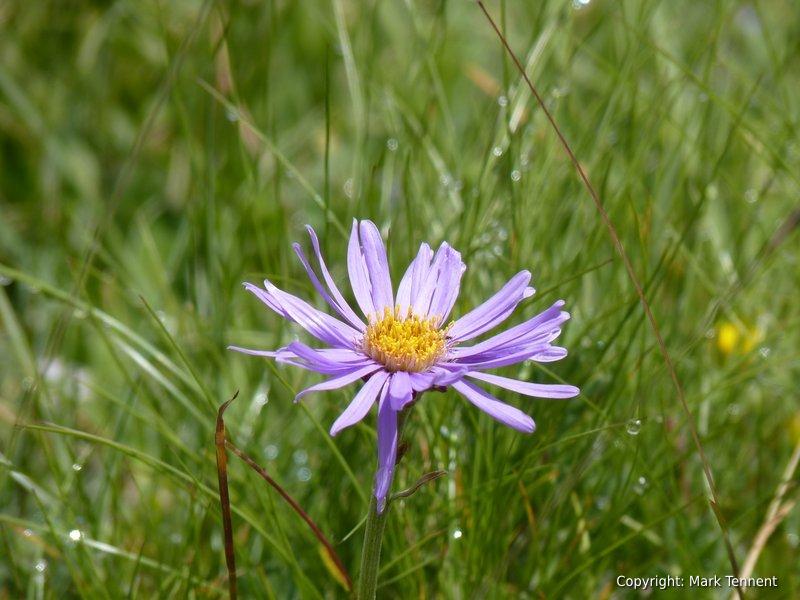
In late May I came across the beautiful Aster des Alpes (Aster Alpinus) growing on the rockface traversed by a via ferrata in the Haute Maurienne.

Aster des Alpes Flower Alpine France
An Aster des Alpes

Alpine flowers and ski resorts

The ski resorts are not typically the best place to enjoy alpine flowers. The developers of ski resorts are not renowned for their environmental sensibilities. Ski runs are ?created? or ?improved? by bull-dozing the ground. Plants that already have to cope with a challenging environment are irrepairably damaged or may disappear entirely. Visit a ski resort in summer and the lines of the ski runs are immediately apparent and the jeep tracks used by the maintenance teams to work on the ski lifts and snow making machinery. Artificial lakes are carved out of the hillside to provide a water supply for snow making. The artificial snow also has a detrimental affect. The density of artificial snow and it’s composition inhibits the growth of certain plants.

Plant Protection in the French Alps

In the French Alps there are a range of protected areas: National Parks, Regional Parks, sites designated Natura 2000**, Reserves Naturelles (Nature Reserves) and R?serves biologiques. Remember many flowers are protected so please don’t pick them.

Identifying Alpine Flowers

I seem to suffer from a form of plant ?dyslexia?. I find it hard to remember loads of names particularly when I’ve learned some in Engish and others in French. Perhaps I should just learn the Latin! My current favourite identification aids include an ?App? called ?Alpine Flower Finder? by Renata Caviglia. You can find it on the Apple store.

Favourite Places ? Around Lac d’Annecy

The Lake Annecy area has to be one of my favourite places. Lac d’Annecy itself is the third largest lake in France with a surface area of 27.59 sq.km. and has very clean water.

Annecy Town

Annecy itself is a bustling town and the administrative capital of the department, Haute Savoie. It is 50km from Chambery and only 40km south of Geneva. Annecy is sometimes known as the ?Venice of the North?. The medieval part of Annecy that adjoins the lake is traversed by the river Thiou. The narrow old streets with ?hidden? passages is a labyrinth of shops, bars and restaurants.

Talloires is very pretty and if you want to spoil yourself a visit to Pere Bise’s Michelin starred restaurant right on the lake-side.

Geography

Over-looking Lac d’Annecy to the east is the edge of the Aravis mountain range. Along the eastern shores there are the mountains of Mont Veyrier, Les Dents de Lanfon and La Tournette (2351m) overlook the lake. The principal road on this side goes through Veyrier-du-Lac, Menthon-St-Bernard and Talloires.

The West side of Lac d’Annecy is bounded by the ?Parc naturel r?gional du Massif des Bauges?. The principal road along this side of the lake passes through Sevrier, St Jorioz and Duingt. At the end of the lake, known as the ?Bout du Lac? there’s a nature reserve with a very pretty, sign-posted, short walk.

The Bauges mountains, a limestone massif, is recognised as a GeoPark by UNESCO. The culminating point is Arcalod ( 2217m). Close to Annecy is the whale-back mountain of Le Semnoz, mainly tree covered, but the ridge is a great view point. In winter there are a couple of ski lifts and tracks for cross-country skiing. In summer herds of cows and goats roam amongst the alpine pastures.

Activities

Walking & Climbing

One of the most challenging walks close to the Lake is La Tournette ( 2351m). The starting point is usually accessed via the Col de la Forclaz and then by a rough track to a farm; the Chalet de l’Aulp. The farm also has a cafe and you can buy their cheeses too. From here a steep path sets off from here passing through an initial exposed traverse before reaching the Refuge de la Tournette. More easy scrambling and grassier slopes lead to the final section to the summit ?block? which is protected by chains and a short ladder takes you to the summit. A superb panorama awaits you.

There’s plenty of easier walking too. Short rambles to longer walks either in the Aravis or in the Bauges. You can find out more about my walks based around Lac d’Annecy and the Bauges on my website.

Swimming

If you enjoy swimming Lac d’Annecy is a wonderful spot. The water temperature can reach the low 20’s in summer. There are a number of ?beaches? where swimming is under the watchful eye of lifeguards within marked areas. You can of course swim elsewhere but at your own risk.

Cycling

On the west side of the lake the old railway line has been converted into a great cycle path that runs the full length of the lake. The cycle path is also shared by people on roller skates and even roller skis and the odd pedestrian too; so you need to be attentive. The east side of the lake is less easy for cyclists although there’s on-going works to increase the amount of cycle path. I tend to start on the East side from Doussard in the morning before the traffic increases. Near St Bernard it’s possible to take small backroads between the main road and the lake to avoid cycling with the traffic.

Paragliding

You are likely to see lots of paragliders flying here is the summer months as it’s one of the premier flying sites in France. If you would like to see what it is like you can take a flight with a professionally qualified instructor. There are many paragliding schools particularly near Echarvines above Talloires.

Golf

There are two golf courses in the area, one at Talloires and the other at Giez; on the way to Ugine.

British Ski Instructors not welcome in the French Alps? Not True!

The British press including the Daily Telegraph and the Daily Mail have carried articles on the arrest of a British ski instructor, Simon Butler, at the resort of Megeve, Haute Savoie. He will appear in court on the 7th April. The articles have been verging on the xenophobic and are quite misleading.

To debunk the myth that British ski instructors are not welcome in the [French] Alps you should note there are currently a large number of British instructors operating entirely legally in France with absolutely no issues with the French authorities or indeed their French colleagues. These instructors hold BASIs highest qualification ?Level 4 ? International Ski Teacher Diploma (ISTD)? This gives mutual recognition in various alpine nations including France.

Simon Butler is apparently no stranger to the French courts. He has already been convicted by the court in Bonneville, Haute-Savoie in 2004 and fined 10,000 Euro. In 2013 he was convicted again. This time he was found guilty and give a 6 month prison sentence and a 10,000 Euro fine which he appealed and has not yet been heard on appeal.

The French system for sports professionals

To help to understand his arrest it is helpful to understand the cultural and legal framework in France. In France the profession of ski instructor (and other sports professionals including mountain guides, mountain walking leaders, rock climbing instructors, kayak instructors, etc, are ?regulated? professions. As such you are required to hold the relevant French qualification or it’s recognised equivalent.

Sports professionals (i.e. working for payment, whether in cash or kind) are further required to declare themselves to the French sports ministry. This is the same irrespective of nationality. The ministry officials will examine the declaration and assuming all is in order issue a ?Carte Professionnelle?. This professional licence gives details of the qualifications you hold and is requested when checks are carried out by ministry officials, supported by the gendarmerie, or following an accident. The penalties for not doing so are quite dissuasive; one years imprisonment or up to a 15000 Euro fine or both.

The European context and France

One of the principles of the European Union is ?freedom of movement?. The main EU Directive that enshrines this is EU-2005/36/EU. This however is not a ?carte blanche? to simply go and start working within another EU state without complying with relevant administrative procedures. As an EU national one applies either for ?Freedom of Establishment? where one wants to establish a permanent presence on French territory or ?Freedom to Provide Services? where the activity on French territory is of a temporary, or occasional, nature.

In respect of sports professionals the local sports ministry officials will then (providing the qualifications and professional experience is deemed sufficient) issue the appropriate authorisation ? a ?carte professionnelle?.

References and Definitions

What is a regulated profession?

A profession is said to be regulated when access and exercise is subject to the possession of a specific professional qualification. (In the UK the ?profession? of ski instructor is not a regulated profession).

?Significant differences?

If the authorities of the host country find significant differences between the training acquired in your country of origin (including your professional experience) and that required for the same work in the host country, they may ask you to complete a traineeship or aptitude test. In the case in question the agreed test is the ?Eurotest?. The Eurotest is a timed GS Slalom.

British Association of Snowsport Instructors

www.basi.org.uk

Relevant European Union Legislation and Guidance

Recognition of Professional Qualifications

http://ec.europa.eu/internal_market/qualifications/index_en.htm

Directive 2005/36/EC

http://ec.europa.eu/internal_market/qualifications/policy_developments/legislation/index_en.htm

French Derogation regarding ski instructor qualifications

http://ec.europa.eu/internal_market/qualifications/docs/ski/com-2000-2262/com-2000-2262_en.pdf

Relevant French Legislation

Code de Sport

http://www.legifrance.gouv.fr/affichCode.do?cidTexte=LEGITEXT000006071318

LIVRE II : ACTEURS DU SPORT

  • TITRE Ier : FORMATION ET ENSEIGNEMENT
    • Chapitre Ier : Formation aux professions du sport (Articles L211-1 ? L211-7)
    • Chapitre II : Enseignement du sport contre r?mun?ration
      • Section 1 : Obligation de qualification (Articles L212-1 ? L212-8)
      • Section 2 : Obligation d’honorabilit? (Articles L212-9 ? L212-10)
      • Section 3 : Obligation de d?claration d’activit? (Articles L212-11 ? L212-12)
      • Section 4 : Police des activit?s d’enseignement (Articles L212-13 ? L212-14)

?Environnement Specifique?

The Code de Sport defines certain situations to be an ?environnement specifique?. In these cases it is deemed that particular safety measures are needed. However it doesn’t go on to define this term. There are several sports / activities that are classed as being in such an environnement including skiing. The Sports ministry has clarified this as being where there is the real possibility of a serious accident (taking into account accident statistics) and how easy or otherwise, it is to evacuate an injured person.

  • « Go to Previous Page
  • Page 1
  • Interim pages omitted …
  • Page 14
  • Page 15
  • Page 16
  • Page 17
  • Page 18
  • Interim pages omitted …
  • Page 38
  • Go to Next Page »

Primary Sidebar

Mark

Mark - Simply Savoie
Mark

Footer

Useful Links

  • FAQs
  • Weather
  • Photo Gallery
  • Privacy Policy
  • Terms and Conditions of Booking

Latest Articles

Stone Stacking in the mountains

Cairns A cairn is a man-made pile (or stack) of stones. The word cairn comes … [Read More...] about Stone Stacking in the mountains

Autumn via ferrata trip to the South of France

Finally the time came to run my first via ferrata tour in the South of France! Saturday, 28th … [Read More...] about Autumn via ferrata trip to the South of France

Follow Simply Savoie on:

  • Facebook
  • Instagram
  • YouTube