• Skip to primary navigation
  • Skip to main content
  • Skip to primary sidebar
  • Skip to footer
  • Facebook
  • Instagram
  • Français
  • English
Simply Savoie Logo

Simply Savoie

Guided walking – snowshoeing – via ferrata in the French Alps with Mark Tennent

  • Home
  • Snowshoe
    • Snowshoe Walking in the Three Valleys
      • Guided Snowshoe Walks Courchevel
      • Guided Snowshoe Walks in Meribel
    • Snowshoe Walking in the Vanoise
    • Guided Snowshoe Weekends in the Vanoise
    • Snowshoe Walking in the Beaufortain
    • Guided Snowshoe Weekend in the Beaufortain
    • Snowshoe Traverse of the Beaufortain
    • Snowshoe Traverse of the Chartreuse
    • Snowshoe Walking in the Haute Maurienne
  • Avalanche Courses
    • Introductory Avalanche Search and Rescue Training Course
    • Intermediate Avalanche Search and Rescue Training Course
    • Avalanche Training Essentials Course
    • Avalanche Awareness Talks
  • Via Ferrata & Rock Climbing
    • Rock Climbing
    • Guided Via Ferrata Weekends
    • Guided Via Ferrata Weeks
    • Via Ferrata in the Hautes-Alpes
    • Via Ferrata holiday in the South of France
  • Walking
    • Centre Based
      • Walking in the Maurienne – Vanoise
      • Walking in the Vanoise
      • Walking in the Beaufortain
      • Walking in the Aravis and Bauges
      • Photography and Walking in the French Alps
    • Trekking
      • Tour of the Vanoise
      • Tour du Mont Blanc
      • The Haute Route – Chamonix to Zermatt
      • The Tour of the Beaufortain
      • Corsica – GR20
      • Tour of the Ecrins
      • Tour of the Queyras
      • 3000m Summits Week
      • The Verdon Gorge & the Haute Provence
  • Custom Guiding
  • About
    • Mark’s Blog
  • Contact

Mark

Why NOT to go to a ski resort in summer

If you are ever planning to enjoy the French alps in summer my recommendation is NOT to go to a place that is principally a winter ski resort. Why?

“Ghost Town”

The place can be like a ?ghost town?. Many of the big resorts make their money in the winter and the summer is sadly just an after-thought. This is clear when you find that most of the shops and cafes are all shut or at best just open from early July to the first week of September. I remember starting out from Val Thorens one August and couldn’t find a single cafe open for a coffee!

Do you enjoy living in the midst of a building site? Another reason is that summer is just about the only time the resort can do construction and maintenance work. The result is sprouting cranes, concrete mixers and builders working frantically to complete new projects while the weather makes this feasible. Dust and noise may be your constant companion.

Industrialisation

Do you enjoy unspoilt nature. Ski lift pylons sprouting amongst the alpine pastures or the bulldozed ski runs partially partially covered with the grass that may have survived being covered in heavily compacted snow. Artificially produced snow from the ?snow cannons? lining the side of the winter ski runs has a averse effect on the types of grass and flowers that will grow. Bull dozed tracks criss cross the ski area to allow maintenance of the ski paraphenalia. The only ?developpement durable? here is the copious amounts of concrete.

Up and down! Ski resorts may be high up with only one road up and down connecting them with the valley bottom. If you want to do anything else than stay in the immediate area of the resort that may be great but otherwise you will find yourself driving up and down the switch back roads to and fro from the valley bottom before being able to visit other neighbouring areas.

Prices. As they say here the prices inflate along with the altitude. The ?Huit a huit? superette, if it’s open, has a very limited stock along with high prices.

Amusement Park in the Mountains

The ?Disneyland des Alpes? – to me Disneyland would be hell on earth and yet many ski resorts seem hellbent on the ?Disneyfication? of the mountains. Sadly the winter ski clientele are largely composed of the ?want it now?, ?instant gratification? generation with no real ?feeling? / connection with the mountains that need no man-made embellishment necessary. The epitomy of this ?enfer? is the ?Folie Douce? – outdoor discos on the ski slopes with pounding music with a bass that can be heard across the valley. This leaves aside the alcohol fuelled debauchery. No thanks.

Recommended Places

Here’s a few of some of my favourite places. Pralognan-la-Vanoise, Beaufort, Areches-Beaufort, Talloires.
Why go snowshoeing?

Snowshoeing has been around since man searched for a way of getting around in deep snow. It’s now a very popular and growing, winter activity.

  • It’s fun! It is suitable for all, young or old, fit or not so fit and it can be enjoyed by the whole family.
  • It’s easy! If you can walk, you can snowshoe?. Within a few minutes you’ll feel at ease and in control.
  • It’s inexpensive! Snowshoes can be purchased for between 100 and 150 Euro and there’s no need for an expensive lift pass!
  • It’s as relaxed or as adventurous as you wish! Take a gentle stroll amongst snow-draped trees or push your limits, the choice is yours. In fact it’s an ideal aerobic, low-impact, exercise.
  • In touch with nature! Snowshoeing allows you to move almost silently so experiencing the peace and tranquillity of the snow muffled landscape. It’s a great way to see the wildlife. In Savoie you may see chamois, ibex (bouquetin), or deer that you will never see in the noisy ski resorts.

Equipment

Snowshoes

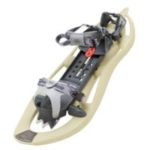
TSL Snowshoe
TSL Snowshoe

Popular brands include: TSL, Tubbs, GV and Inook. For those unfamiliar with snowshoes it may conjure up images of a pair of tennis racket-like things attached to your feet. In fact modern snowshoes are high-tech and made from plastic or are aluminium framed. The size of snowshoes is related to your weight so, in general, snowshoes for women are smaller than they are for men. Most are very simple to adjust for the size of your footwear and then a simple binding system attaches them to your boot.

The idea of the snowshoe is to spread your weight so you don’t sink into the snow; or at least not nearly so much, giving access to places impossible on foot. Going up hill is made easier with the use of a heel lift feature which means there’s less strain on your calf muscles. Grip is provided by small metal spikes (crampons) under the snowshoe that will stop you slipping on hard snow or patches of ice. At the front there are “claws” or “front points” which provide grip when going directly up steep slopes.

Ski or Trekking Poles

A pair of ski poles / trekking poles with large “snow baskets” can aid your stability and also provide additional impetus to your stride. Real Nordic walking.

Boots

You don’t need special boots; a pair of good walking boots / snow boots is ideal, with gaiters or a pair of trousers with a snow cuff the ideal companion to avoid snow entering the top of your boots.

Clothing

No special clothes are needed. Warm clothes e.g. fleece jackets, wind/waterproof jacket, hat, gloves as you would wear for walking in the winter.

Extras

Don’t forget your sunglasses and some sun cream! A small rucsac is recommended to carry an extra windproof /waterproof top, fleece jacket, a drink and snacks.

Technique – a few tips

Snowshoeing doesn’t have a steep learning curve but a few tips will soon have you moving around confidently enjoying a new-found freedom.

On the flat

Your style of walking will need to take account of the width of the snowshoe and to avoid stepping on the other snowshoe. It’s best to start out on a level path or track whilst you get accustomed to them. Turning around is best accomplished by turning in small steps until facing in the new direction or doing a “kick turn”.

Downhill

Going downhill is easiest, and the most fun, in deep powdery snow. Raise the toe slightly allowing the tail of the snowshoe to come into contact with the snow first. Try to walk confidently with a good transfer of weight from one foot to the other. The snowshoe may slide forward a bit but avoid the temptation to lean back. You can use your pole to provide extra balance but avoid using them directly in front of your body. On firm snow place the snowshoe flat on the ground so that the crampons can “bite”.

Uphill

Unless it’s a very short distance, “zig-zag” up the slope using the terrain to best advantage. This puts less strain on the legs and you’ll gain height surprisingly easily. If you encounter a very steep bank you can use the “claws”/”front points” of the snowshoe.

Traversing

This is easiest in soft snow conditions where you can still place the snowshoe down normally. When the snow is firm you will need to roll the ankle to allow the snowshoe to lie flat on the slope, thus allowing the crampons to “bite”.

Etiquette

If you’re snowshoeing avoid walking on prepared “pistes” for cross-country skiers as the railway like “tracks” are damaged by walking on them. Skiers may also approach fast and you don’t want to be involved in a collision. In ski resorts try and avoid the pistes but if you have to, cross quickly or walk up or down the edge of the piste.

Precautions

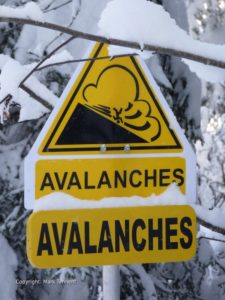
Danger Avalanches Sign
Beware of Avalanches!

Naturally if you go into more mountainous terrain you should be aware of the risk of avalanches. You should then carry normal avalanche equipment (avalanche transceiver, shovel and probe) and most importantly know how to use it. Let someone know where you are going and when you intend to be back.  Read my article on Mountain Rescue in the French Alps.

Where?

You can go snowshoeing anywhere there is snow!

On paths and tracks you don’t need much depth however going through woods it’s best with a bit more depth that covers The ground can be flat, undulating or even on more mountainous terrain. The world’s your oyster!  Of course you can always join me on a Guided Snowshoe holiday.

Article copyright: Mark Tennent – all rights reserved

Why choose a locally based walking guide in the French Alps?

Why choosing a locally based walking guide in the French Alps is your best option.

Before you book your next guided walking holiday in the French Alps you may wish to consider the following questions.

Will your walking guide really have ?Local Knowledge??

Many walking holiday companies based outside France talk about the experience of their guides and talk of them as being ?local experts?. Really? The vast majority are certainly not ?local? and, arguably, far from ?experts?.

What is ?local knowledge?? a definition:

?Refers to facts and information acquired by a person which are relevant to a specific locale or have been elicited from a place-based context. It can also include specific skills or experiences made in a particular location.?

Can a walking guide who is ?parachuted in? for a few weeks have the same level of local knowledge as one who lives there all year? Simple logic would suggest, ?No?.

How well does your guide speak French?

Communication is key. When you get off the beaten track English isn’t always spoken or understood.

  • What happens if you have an accident or an emergency? Can your walking guide communicate clearly with the rescue services, a doctor, or at a hospital?
  • You may want help to understand a menu in a restaurant to guide you in your choice; especially important should you have a food allergy or special diet.
  • If you are staying in smaller hotels or mountain refuges can your guide act as your interpreter to make your stay an enjoyable one? Can they help you to break the language barrier between you and others?
  • Can they talk with other walkers on the trail and bring you into the conversation or exchanging information on conditions with other walking guides? This can be a major safety factor.

How choosing a local based walking guide contributes to ?Sustainable? Tourism

Sustainable tourism is a phrase that appears in most brochures or on websites. What does it mean in practice? It is about reducing the impact of tourism in a variety of ways:

  • Informing yourself of the culture, politics and the economy of the area that you will be staying in or walking through. What depth of knowledge does your walking guide have?
  • Anticipating and respecting the local culture and the expectations and assumptions that go with it. A locally based walking guide living, year-round in France can help you avoid making social faux pas, and enhance your experience.
  • Supporting the integrity of the local culture by [sic] choosing to support locally based walking guides or companies.

By choosing a French based and French speaking walking guide you truly contribute to the local economy.

What knowledge do they have of the wildlife and wild flowers?

Seeing wildlife and wild flowers is an important part of a walking or trekking holiday in the Alps. I can help you to spot ibex (bouquetin), chamois, bearded vultures not to mention the ubiquitous marmotte! Some are common and easy to spot, others can be more elusive. By knowing their favourite hang outs I can increase your chance of seeing them. Let me guide you in discovering the kaleidoscope of wild alpine flowers that never fails to inspire me; especially genepy!

Can they help you discover French food, wine and other local produce?

France is world renowned for its gastronomy, great wine and fresh, local produce. It forms an essential part of any walking or trekking holiday in the Alps. A locally based walking guide can help you fully discover local specialities and not just the run-of-the-mill items on every menu.

I can take you to alpine farms where cheese making still happens ?sur place? (on site). Here you can watch this timeless tradition taking place. Huge copper cauldrons brimming with milk direct from the cows, their bells tinkling in the alpine pastures. You can taste the cheeses maturing in the farms cellar and may be buy some to take home with you.

You may know your French wines, Bordeaux, Cote de Rhones, Chablis, etc. However let me introduce you to the local Savoie wines. Savoie wines are comparatively little known due to the very small quantities produced and sometimes they are produce from grape varieties rarely grown elsewhere in France.

Is the walking guide legally allowed to work in France?

Is your potential walking guide legal to work in France? Does your guided walking holiday company only employ walking or hiking guides legally able to work in France? If not you run the risk that your guide is arrested and your holiday ruined. Find out more.

Well, why choose me, Mark …

I’ve lived near Albertville, Savoie, in the French Alps since 2005. My home is in a small rural hamlet on the mountainside that forms part of the Chaine de la Lauziere between Albertville and the Col de la Madeleine.

I speak fluent French, albeit with a British accent, except when I’m working I rarely speak English. I’m currently applying for French citizenship.

All my neighbours are French. As I said to them, ?I didn’t move here to be part of an English speaking ?ghetto? like Chamonix or Meribel?. I now feel ?I belong? and several years ago I was touched by being introduced by my closest neighbour, a retired farmer, a Savoyard ?de souche? (born and bred) as a Villaret (someone from Le Villard). It was a milestone in being accepted into a tightly knit community where the local patois is still spoken.

Let me share my local knowledge with you. It’s an accumulation of my day-to-day life experience in France. So please allow me to bring your holiday ?alive?!

Vultures in the French Alps

There are three types of vultures in the French Alps.? These are:

  • The Bearded Vulture or Lammergeier (French: Gypaete Barbu; Latin: Gypaetus barbatus )
  • The Griffon vulture (French: Vautour fauvre; Latin: Gyps fulvus )
  • The Eurasian Black Vulture or Cinereous Vulture (Latin: Aegypius monachus; French: Vautour Moine)

The Bearded Vulture

Concerning the Gypaete Barbu, as of 2013 there were nine breeding pairs in the French Alps seven of which are resident in Savoie & Haute Savoie.? Overall in the Alpine ?Arc? there are just twenty-seven breeding couples; so the French Alps do quite well here!

This makes me realise quite how fortunate I am to see this magnificent bird on a regular basis.? During this last winter almost each time I’ve gone to area of Champagny-le-Haut I’ve had a sighting of the gypaete.? On one occasion it ?performed? for about five minutes, soaring effortlessly along the south-facing slopes of the valley looking for its next meal.? The other area where I’ve observed the vulture is leading up to the Col de la Vanoise from Pralognan-la-Vanoise.
The gypaete had completely disappeared from the Alps at the beginning of the 20th century.? Today, even though there is some optimism it remains one of the most threatened in Europe.? This despite an introduction programme that has gone on for 30 years.

The Gypaete lives for about 30 years.? After 6 years its chances of survival approach 95%.? It doesn’t reproduce until it reaches 8 years old and produces on average 1 off-spring every 3 years.? So the rate of population growth is extremely slow and any disturbance causing a reduction in this rate has a marked affect on the species rate of growth.? An interesting fact to note is that vultures return to the place they first flew.? Vultures fitted with gps trackers have been logged flying from the Vanoise to Austria, back via Italy and then heading as far as Madrid in Spain before coming back stopping off in the Cevennes!? An impressive journey.

The gypaete is a very curious bird and it’s not rare to see it approach man.? At the same time it’s fearful and sensitive notably in the proximity to it’s nesting area.? The ?Le Projet LIFE Gyphelp? is not about trying to ban everything but about finding a way to reconcile human activities and the tranquility of the species.

Threats to the vultures

The greatest risk to vultures include: poisoning, collisions with overhead cables and disturbance.

Poisoning is not necessarily deliberate.? Sometimes it is as a result of the vultures eating the carcases of dead farm animals that have been given drugs by vets.? The anti-inflammatory drug ?Diclofenac? is fatal to vultures.? Another source of poisoning is the ingestion of lead fragments from animals killed by hunters.? The lead in animal remains is ingested by the bird and given the extreme ph value of the gypaetes gastric juices (around ph 2) the lead is dissolved.? This then enters the blood stream and bird ends up dying from lead poisoning.

Collisions from overhead cables in the form of electicity cables or ski lift cables is known to have been the cause of death of a number of birds.? Thanks to the action of the ?Projet LIFE GypHelp? the more critical cables have been fitted with warning markers that has decreased the fatality level for birds and not just the vulture.

Human disturbance to vultures, particularly when nesting, can cause the birds to abandon the nest and its eggs or young off-spring.? These disturbances can be the result of a range of outdoor activities and photography.? One breeding pair were disturbed by ?speed riders? (a small paraglider with the person on skis) near Peisey-Nancroix and they deserted the nest with a young bird that subsequently died.? The people involved have been prosecuted in the courts.

You can find out more on the following sites.

www.gypaete-barbu.com

www.facebook.com/centreelevagegyp

http://www.vautoursenbaronnies.com/

Unqualified walking guide in France – the risks

The immediate risk is that your unqualified walking guide or hiking leader could be arrested at any time leaving your holiday ruined. You may then find yourself required to give a statement to the police as part of their investigation. Clearly not how you wish to spend your holiday.

An unqualified walking guide – your safety at risk

Most importantly your safety and well-being could be at serious risk. What if the weather suddenly changes? Can your leader navigate in difficult conditions? If your route crosses steep, rocky terrain or even makes use of steep ladders and wire protected passages does your leader have the skills and experience to keep you safe? Early summer in the Alps large areas of old snow can make normally easy routes very serious with a trip or a slip potentially having serious or fatal consequences. Can your leader protect your safety?

The benefits of using a qualified walking or trekking guide

No. 1 ? Your safety & well-being.

  • Your leader will have been assessed on their navigation and map reading skills. In good weather finding the right route may be easy but even in summer in the Alps snow can rapidly cover footpaths and way marks. Low cloud may suddenly make route finding more challenging.
  • Your leader will have been trained and assessed in the use of the rope to protect you on steep ladders, wire protected sections of the route or even large areas of snow lingering from the winter. These can look innocuous but a slip and an uncontrolled slide may have very serious consequences.
  • Your leader has to undergo regular refresher training or ?Continued Professional Development? to ensure their skills are up-to-date.
  • Your leader is required to have a good knowledge of the flora and fauna helping you to get the most from your holiday.
  • Your leader will have been trained in First Aid, usually a course specifically for remote environments in the mountains.
  • Your leader is required to hold Professional Indemnity Insurance.

By insisting on only using a qualified Accompagnateur en Montagne (AeM) or International Mountain Leader (IML) you are assured of a leader who has gone through a thorough training and assessment programme.

It is also worth checking how your holiday insurance may be affected. In some cases your insurance may be invalid if you are injured when in the company of an unqualfied leader potentially leaving you with a large bill.

The Legal Situation in France

France has strict laws (references below) on who can lead walking, hiking and trekking tours. Indeed this applies to other outdoor sport professionals such as mountain guides (guide de haute montagne), rock climbing and ski instructors. There’s no requirement for leading genuine friends or family. The purpose of the laws is protect the public.

Consequences for an unqualified walking guide or mountain leaders

Regular checks (or contr?les) are carried out by inspectors from the DDCS or the Peleton Gendarmerie de Haute Montagne (PGHM) who also carry out mountain rescues. If they suspect someone is leading a group they will ask for proof of the leaders qualifications and to see if they have registered to work in France. Should they discover that a person is not qualified they may arrest them on the spot. These unqualified leaders face up to 1 years imprisonment and / or up to a Euro 15,000 fine.

A person who is remunerated for leading walks or hikes for (which includes payment in kind) is required to hold the relevant qualification or its recognised equivalent. They are also required to register with the French Sports Ministry. Those who work on a regular basis or are resident in France will also be issued with a ?Carte Professionnelle? with their photograph and a link to the qualifications they hold.

Protectionism?

It’s often decried as France being protectionist. Not true. Any person who holds the recognised qualification or equivalent may work in France regardless of nationality. As a UK national it was a straightforward administrative matter to have my International Mountain Leader qualification recognised. The same is true for IFMGA Mountain Guides and ski instructors. There are at least 350 British ski instructors working perfectly legally in France with no hindrance.

References

Code du sport – Article L212-1 (in French)

Code du sport – Article L212-2

Tour of the Vanoise – Article for “Mountain Passions”

History

The Vanoise National Park was France’s first national park created in 1963 covering an area of 520 sq km. The culminating point of the Vanoise is the Grand Casse which rises to 3855m which was first climbed by William Matthews in 1860. The Park shares a 15km common boundary with the Grand Paradiso National Park in Italy. There are over 107 summits that exceed 3000m. The Vanoise, located in the department of Savoie, stretch from the border with Italy just beyond Val d’Is?re and Bonneval-sur-Arc to the Col de la Madeleine bounded by the valleys of the Tarentaise and Maurienne. The Savoie department formed part of the independent kingdom of Savoie Sardaigne that only became part of France in 1860. Savoie’s administrative centre is located in Chamb?ry.

The Vanoise National Park remain unspoilt due to strict controls on construction and development.

The Tour

The route described here is sometimes known as the Tour des Glaciers de la Vanoise.

One of the great beauties of this tour, apart from the superb scenery, is that you don’t drop down to a valley again until the end of the tour. Likewise you will not pass through villages, and walk close to roads. Having said this the tour is well provided with mountain refuges that provide simple accommodation and where you meet like-minded people.s

It is, in my opinion, a better tour than the one described passing through the village of Val d’Is?re and Tignes with the cancerous protuberances of the ski industry. Compared with the Tour du Mont Blanc you stay at altitude during the whole tour and need only touch tarmac road for 50m from start to finish.

There’s a choice of natural starting points, either Pralognan-la-Vanoise, (accessible from Moutiers in the Tarentaise valley) or Modane (in the Maurienne Valley). The route I will describe starts from Pralognan-la-Vanoise.

If you take the route in a clock-wise direction the first day is a gentle one that leads via the Lac des Vaches to the Col de la Vanoise; at the foot of the Grande Casse. The route follows the ancient ?Route du Sel?; an old trading route going back 100’s of years. The col, with the refuge Felix Faure, makes a wonderful spot to spend the night. The marmottes here are particularly friendly. If you have energy to spare you can explore the area around the col and perhaps walk up to the edge of the glacier.

The path now heads past Lac Bond and the Lac du Col de la Vanoise, only losing a little height, before contouring right around the hillside. There’s a junction here with the path to Entre deux Eaux and a road to Termignon in the Maurienne. The path climbs gently but in general it follows a natural balcony passing below the glacier de Pelve above and the deep gorge of the Doron du Termignon. The views to the south are outstanding, a panorama of mountains that form the Italian frontier. The only road across this range passes over the Col de Mont Cenis. Soon the Arpont refuge comes into sight, built into the moraine and thus protected from avalanches.

The journey continues high above the Maurienne crossing tumbling streams on the steep flanks of the mountains below the Dent Parrachee. The shepherd’s huts of La Loza perched on a spur are passed before a zig-zag descent crossing some steep ravines brings us out above the village of Aussois. Here two lakes, the Plan d’Amont (higher) and the Plan d’Aval (lower) provide hydro-electric power. A few ski lifts make their appearance as the national park’s boundary bends inwards. There’s a choice of refuges, Plan Sec, La Dent Parrachee or the Fond d’Aussois. Take your pick but I like the traditional, rustic, Dent Parrachee with Franck the friendly guardian.

Today’s ?normal route? crosses over the valley and passes via the Col Barbier (2287m) sharing the line of the GR5 on it’s journey south, before traversing more alpine pastures. Be aware of the ?patous? who may be guarding the herds of sheep (the best advice is to stop and wait for them to see that you are not a threat and then to move slowly). The route now drops down through pine woods and passes through the edge of a boulder field before regaining height to reach the L’Orgere. Here there’s the first sight of tarmac since leaving Pralognan-la-Vanoise and a chance for a bit more comfort if you wish. For those wanting more of a challenge you can take the ?direct? route via the Col de la Masse (2923m) with an equally challenging, for the knees, descent to the l’Org?re. This area is often frequented by chamois.

The next section climbs in a few zig-zags above l’Orgere before easing off and eventually passing the lac de la Partie. Above and to the left is the Aiguille Polset and the Glacier de G?broulaz however the route makes for the natural crossing point, the Col de la Chaviere (2796m), the highest ?obligatory? col on any GR in France. A short steep descent on loose ground leads to a meandering route through old moraine and boulder fields. Soon the refuge Peclet-Polset is reached, a very modern refuge, the old one burned down in a fire. If you want a little more exercise you can reach the Lac Blanc in about 15 mins from here.

The valley that extends below is the start of the Doron and soon you are amongst the pastures again on a well-defined track. Make a choice at the farm of Le Ritort either to carry on in the valley bottom or you can climb up and traverse below the Glacier de Genepy before regaining the valley floor near the hamlet of Prioux. Here the tarmac commences again but leave the end of the hamlet and walk down the left-hand bank to reach the road that’s crossed to immediately to follow a track all the way to Pralognan-la-Vanoise, and the end of the Tour.

Wildlife

Keep your eyes peeled for the relatively rare Bearded Vulture (Gypaete Barbu) with it’s wingspan approaching 3m! It feeds on carrion so is one of nature’s recyclers! It has the habit of dropping large bones from altitude to smash them open on rocks. There is a pair nesting not far from Peisey-Nancroix and the vultures have a territory of between 100 and 700 km2.

The park is famous for its large population of Bouquetin (Ibex) who were almost hunted to extinction. Now there’s approaching 4000 and they are relatively approachable. The males are identified most easily by their large, almost 1m long, scimitar shaped, knobbly horns. The females have shorter horns that are less ?knobbly?.

Chamois (Rupicapra rupicapra) are highly agile and have hooves adapted to their preferred terrain of steep rocky ground where they feel safe from the threat of two-legged hunters. They have a white ?blaze? on their cheeks and short horns that curve just at the top. If you’re lucky you may see a young chamois (cabri) with it’s mother.

You will undoubtedly encounter the cuddly looking Marmotte but your first awareness of it’s presence is likely to be a shrill whistle. This whistle is their warning cry to alert other members of their group that there’s a threat. The nature of the whistle changes to reflect whether it’s a ground or aerial threat.

Flowers

Wild flowers are probably at their best in June and early July. This depends on how quickly the winter snows melt. Keep your eyes open for the iconic edelweiss and the g?n?py that gives it’s name to the pale-ish liqueur. Naturally you should come across the stunningly beautiful blue gentiane. Please note that in the Vanoise National Park that picking the flowers is forbidden.

When

The main limiting factor is availability of the mountain huts (refuges); the second, in the spring, being the snow remaining from the winter. The refuges normally open around mid-June (exact dates can be found on www.refuges-vanoise.com and they typically close in mid-September despite the weather often being good at this time of year.

Equipment

You should only require ?normal? mountain walking attire plus a sheet sleeping bag for using in the refuges. You can read an article here on staying in mountain refuges (Link to Simply Savoie).

Getting there:

The principle airports are Lyon, Geneva (in Switzerland), Grenoble. Chamb?ry’s airport is principally a winter point of entry for skiers flocking to the ski resorts.

By rail the TGV gets you quickly to Chamb?ry (only 2hrs 30 from Paris) and then you can easily get to either Modane or Moutiers. From Moutiers buses or taxis are available to Pralognan-la-Vanoise.

  • « Go to Previous Page
  • Page 1
  • Interim pages omitted …
  • Page 12
  • Page 13
  • Page 14
  • Page 15
  • Page 16
  • Interim pages omitted …
  • Page 38
  • Go to Next Page »

Primary Sidebar

Mark

Mark - Simply Savoie
Mark

Footer

Useful Links

  • FAQs
  • Weather
  • Photo Gallery
  • Privacy Policy
  • Terms and Conditions of Booking

Latest Articles

Stone Stacking in the mountains

Cairns A cairn is a man-made pile (or stack) of stones. The word cairn comes … [Read More...] about Stone Stacking in the mountains

Autumn via ferrata trip to the South of France

Finally the time came to run my first via ferrata tour in the South of France! Saturday, 28th … [Read More...] about Autumn via ferrata trip to the South of France

Follow Simply Savoie on:

  • Facebook
  • Instagram
  • YouTube