
• Skip to primary navigation
  • Skip to main content
  • Skip to primary sidebar
  • Skip to footer
  • Facebook
  • Instagram
  • Français
  • English
Simply Savoie Logo

Simply Savoie

Guided walking – snowshoeing – via ferrata in the French Alps with Mark Tennent

  • Home
  • Snowshoe
    • Snowshoe Walking in the Three Valleys
      • Guided Snowshoe Walks Courchevel
      • Guided Snowshoe Walks in Meribel
    • Snowshoe Walking in the Vanoise
    • Guided Snowshoe Weekends in the Vanoise
    • Snowshoe Walking in the Beaufortain
    • Guided Snowshoe Weekend in the Beaufortain
    • Snowshoe Traverse of the Beaufortain
    • Snowshoe Traverse of the Chartreuse
    • Snowshoe Walking in the Haute Maurienne
  • Avalanche Courses
    • Introductory Avalanche Search and Rescue Training Course
    • Intermediate Avalanche Search and Rescue Training Course
    • Avalanche Training Essentials Course
    • Avalanche Awareness Talks
  • Via Ferrata & Rock Climbing
    • Rock Climbing
    • Guided Via Ferrata Weekends
    • Guided Via Ferrata Weeks
    • Via Ferrata in the Hautes-Alpes
    • Via Ferrata holiday in the South of France
  • Walking
    • Centre Based
      • Walking in the Maurienne – Vanoise
      • Walking in the Vanoise
      • Walking in the Beaufortain
      • Walking in the Aravis and Bauges
      • Photography and Walking in the French Alps
    • Trekking
      • Tour of the Vanoise
      • Tour du Mont Blanc
      • The Haute Route – Chamonix to Zermatt
      • The Tour of the Beaufortain
      • Corsica – GR20
      • Tour of the Ecrins
      • Tour of the Queyras
      • 3000m Summits Week
      • The Verdon Gorge & the Haute Provence
  • Custom Guiding
  • About
    • Mark’s Blog
  • Contact

Blog

Becoming a Ski Instructor in France

Despite the assertions of some of the UK press there is no discrimination against British instructors. There are currently around 350 British ski instructors working in France entirely within the law.

The first hurdle for any aspiring ski instructor, French or otherwise, is to pass the ?Test Technique?. The Test Technique is a slalom course that has to be completed within 20% of the course ?openers? adjusted time.

An ?opener? is a top-level skier who skis the course. The time achieved is then adjusted according to their ?handicap? to arrive with ?base time?. 20% is then added to this time and this is the target required to pass.

Once past the Test Technique there’s a two week training course known as the Pre-Formation where you learn to teach beginners to ski. A one day test completes this phase. You are now issued with your ?Livet de Formation? (a training logbook) and are classed as a ?Stagiaire? (trainee instructor). As a trainee you can work within an approved ski school (known as a ?Centre de Formation?) under the guidance of a training advisor. You now have 3 years to pass the next phase …

The Eurotest. This is a giant slalom and once again you have to complete the course within a 18% percentage of the ?openers? time. Some British qualified instructors come direct to this test if working through the BASI (British Assocation of Snowsports Instructors) and wishing to work in France.

The training process is far from over with further training courses; the first lasting four weeks and the second five weeks. These training courses cover teaching, skiing off-piste, ski touring and avalanche safety. On successful completion the full diploma is awarded and you can teach independently or within any ski school.
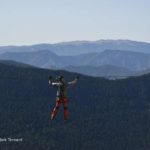
Vultures and via ferrata in Haute Savoie

After meeting up in Albertville and decision made it was off to the Col des Aravis and the via ferrata Yves Pollet-Villard on the cliffs overlooking the col.

Arrving at the foot of the route after about 20 minutes we geared up.? There was a large group that seemed to comprise several families with young children the youngest probably around 8 years old.? They set off before we were ready but it was only a moment before one of the children was in tears and descended with the aid of one of the adults.? I was surprised to see children of that age un-roped as it’s highly advisable with children (and effectively obligatory when working professionally with them).? I certainly rope up my youngest daughter (9).

It was a beautiful autumn (at least a couple of days before it’s official start) day with blue skies but without the intense light of summer.? The Pierra Menta in the Beaufortain could be seen in the distance and the Glacier de la Vanoise.

Soon we reached one of the key features of the route a “Nepal” bridge gained after a short descent round a nose of rock.? I went ahead so that I could take a video of this section with a terrific backdrop of alpine pastures, chalets and the limestone bulk of La Tournette in the distance.? We continued to a flattening where we stopped to enjoy our sandwich and drink in the views and breath in the fresh, alpine air.

Movement caught my eye below and saw me reaching for my camera as a “Bearded Vulture” (Gypaete Barbu – fr) or Lammergaier thermalled effortlessly below above the pine trees below the cliff.? It circled gaining height as it rose along the line of the cliff.? I snapped away hoping to get a good shot.? It’s a majestic bird with an adult’s wingspan reaching c. 2m 80cm.? After this perfect demonstration of thermalling that I could never match when I paraglided we moved on.? It’s moments like this that make my day and sharing this moment with Helen and Owen was a highlight of the day.

Soon we were below the exit with two choices, one over the short overhang or two an easy traverse of the ledges and up a short gully.? There wasn’t much of a discussion, the overhang beckoned.? After dropping off the rope coils I had tied off around me I quickly installed myself above so that I could give a direct belay, more for my own peace of mind.? Helen and Owen made short work of it and the rope wasn’t required but there “just in case”.? A few minutes later we were at the finish and getting out the remainder of our food and just enjoying relaxing in the sun after a great few hours spent together in a picture-postcard environment.

Walking the Blanc-Martel footpath in the Verdon

I took a detour on my way from the Pyrenees to my home at St Paul sur Isere via the Verdon in the Haute Provence. I was keen to walk the Sentier Blanc-Martel, the classic footpath in the depths of the Verdon Gorge. The path is name after a geologist, Edouard-Alfred Martel and his guide Isidore Blanc a teacher from the village of Rougon who explored the Verdon in 1905.

I camped for the night at Moustiers-Sainte-Marie and got up early at 6.00 a.m. to enjoy the freshness of the morning. A drive along twisting roads took me to La Palud-sur-Verdon where I turned off to take the road to the Chalet de la Maline; the starting point of the Sentier Blanc-Martel. I took 3 litres of water with me as, apart from going down to the river itself, there’s no water available on the path.? The path left just next to the Chalet (a ?refuge? owned by the CAF – French Alpine Club). I followed descending zig-zags amongst box and scub oak. Having left so early I met no one ? great! The sun was just hitting the opposite side of the gorge. Soon I was down a short distance above the river and a path junction indicated the bridge of the L’Estellie.? The sound of birds in the trees and the sound of the river Verdon below me were the only sounds I could hear, apart from the crunch of my boots on the path. Soon I was at the L’Eboulis des Guegues, a large scree shoot. To avoid erosion stone steps led down to a stabilised path across the scree to more steps and an iron handrail to reassure the more nervous.

The next junction I encountered indicated La Mescla to the right and the Baume aux Boeufs and the Breche Imbert to the left. The path climbed and I came to a short section of metal steps that led to a view point at the top of the Breche Imbert. The Breche (gap) is the ?crux? of the walk. I stopped to take some photographs and drink some water and take a snack.? A long section of metal steps with handrails made getting down the far side easy with several intermediate ?landings?. Fortunately I had still met no one and the narrow ladders would make passing ?interesting? if the route was busy.

The path continued with shafts of sunlight filtering through the small oak trees. A tunnel now, the remains of an abandoned project to bring water to cities of Toulon and Marseille in the South of France. The first tunnel, 115m long, was straight and I didn’t need to get my headtorch out. The second tunnel, the Trescaire, was another matter as it is 650m long and curved. The headtorch was pretty much essential although towards the end several galleries gave glimpses of the Couloir Samson (a narrow gorge in the Verdon).? Finishing the tunnel by some more metal steps I walked just above the roaring river Verdon and crossed a bridge over the Le Bau, a small tributary. I met a parking place but crossed over and up a path amongst scrub that took me up to the Pointe Sublime. Here I sat down for more to drink and eat before hitching a lift back to my car with some Italian tourists. A great day out.

Via ferrata in the Aravis – Tour de la Jalouvre

Another beautiful sunny day in Savoie and Haute Savoie of the French Alps.? We set off to the Aravis, a mountain range between Annecy and Megeve that includes the winter resorts of La Clusaz and Le Grand Bornand.

The via ferrata the Tour de la Jalouvre is located between Le Grand Bornand and the Col de la Colombiere.? After a short walk with the sound of cowbells in our ears we reached the foot of the route.? The first section is generally straightforward apart from a small overlap where the arms are woken from their slumbers.

Higher up is the tower, the aptly named “Pilier des Courants d’Air” that is reached by crossing the bridge “Passerelle du Gypaete”.? The pillar is steep with exposure below one’s feet but a steady, calm approach brings you easily to the top.? From here the angle eases although the exposure continues.? Now on the crest of the long spur easy but continuous climbing brought us to the top of the route.? After some lunch it was time to attack the descent across paths and limestone karst.? Movement in the sky attracted my attention and I spotted a “Gypaete” (Bearded Vulture or Lammergaier) gracefully traversing the mountain-side.? After a final cable protected descent we gained the large couloir that leads to the summit and a steep but steady descent.

The Via Ferrata de Roche Veyrand, Chartreuse

Today saw us head west to the Chartreuse mountains probably best known for the liqueur of the same name originally produced by the monks in their monastery located in the massif.

We drove over the Col du Granier and down into the heart of the Chartreuse to the village of St Pierre d’Entremont.? We parked by the mairie and popped across the road to pick up some fresh bread for lunch.? Sacks packed we set off for the walk up to the foot of the Roche Veyrand that takes about 30 minutes.? We arrived at the base of the cliffs having traversed beech forest shading us from the growing heat of the sun.

The route starts off up steep slabs that give views out over the valley and surrounding mountains of the Chartreuse.? The via ferrata is divided into three sections with the possibility to cut short the route if needed.? A couple of bridges add to the entertainment.? The “meat” of the via ferrata is the final, upper section and after crossing a 30m long bridge you are faced with a steep wall that leads to a line of caves in the limestone headwall.? From here a long traverse with rapidly increasing exposure takes you out on this very impressive rock face.? The via ferrata now climbs steeply up before moving diagonally right to reach the “crux”.

The final section requires you to traverse under a bulging roof before committing to the bulge with a drop of around 300m below your feet.? Soon the angle eases and a final section leads to a clear grassy area and a chance to enjoy the view and take a break.

It was interesting to see the “translation” of the original French book (published by Libris)? “Toutes les Via Ferrata de France” published by Cordee in the UK.? This route doesn’t appear at all!? There’s also a rather worrying error regarding the “Grotte a Carret” above Chambery which is amongst the hardest via ferrata (graded ED) in France and the scene of numerous rescues.? The route described in the English translation as the “Grotte a Carret is close to the Croix du Nivolet much further to the left.? It describes this route as PD (much easier) and it would be worrying to see people ending up on the real route and facing an entirely different proposition.? There’s also another route to the right of the Grotte a Carret known as the P’tchi which is excellent and doesn’t appear in the English version of this guide.? The editor or proof reader must have been asleep!

Snowshoeing at Pralognan-la-Vanoise

Pralognan-la-Vanoise, Pralognan or Pralo’ for short, is a ?gateway? to the Vanoise National Park and one of my favourite bases there is the Hotel Grand Bec.

Pralognan nestles in the valley surrounded on all sides by high mountains. There is only one way in by road, summer or winter. In winter the village is literally at the end of the road and the only way on is by foot on skis or snowshoes. In summer you can drive up to a car park near the hamlet of Prioux or to the hamlet of Les Fontanettes.? Pralognan retains a traditional village feel; unspoilt by the ravages of the ski industry.

Today’s walk took us up the continuation of the valley. Our snowshoe walk started from the camp site and we took advantage of the shelter of the pine forests as we gained height along the tumbling river Doron. Soon snow started to fall. Ours were the only tracks in the snow as we passed the hamlet of Prioux. High above the edge of the Glacier de la Vanoise appeared from the clouds as patches of sunlight spotlighted the hills. Approaching the Refuge du Roc de la Peche a lone male ibex stood sentinel, dwarfed by the huge slopes.
We entered the ?boot room? at the Refuge and exchanged boots for hut shoes. Inside a hot chocolate and an omelette supplemented our picnic lunch. We were the only customers until a guide appeared on skis with a couple of clients. A great day.

The Grande Casse, the Vanoise mountain range’s highest peak at 3855m, dominates the Col de la Vanoise, today’s objective. We ?cheated? by making use of two chairlifts to gain Les Barmettes saving around 500m of ascent from Pralognan. Avalanche transceivers on and checked we left the skiers behind us and soon entered the ?heart? of the Vanoise National Park itself. The mountain side to the left attracted our attention and we soon made out numerous ibex feeding on the south facing terraces. Onwards and upwards, as we roughly followed the line of the summer path, the ancient ?Route du Sel?. Our only company a couple of ski mountaineers. We reached and crossed the snow and ice-covered Lac des Vaches; a picturesque spot in the summer beneath the imposing rock face of the Aiguille de la Vanoise.

The glaciated Grand Couloir on the Grande Casse drew the eye as we reached the area of Lac Long, not far from the Col de la Vanoise itself. After an inspection of the slope leading towards the refuge the decision was taken to have our picnic surrounded by the wild grandure of the mountains surrounding us.

Four other days, all different, but each special in their own way, completed the week. A visit to the valley of Champagny-le-Haut was rewarded with a flying display by the Bearded Vulture. Setting off from Chamberanger took us up through snow-covered alpine pastures and pine woods to reach a little alpine hut looking out over mountains stretching away in the distance. Passing through the old, almost-abandoned village of Montcharvet underneath Le Dent du Villard. Discovering the lower slopes of the Dent du Portetta high above Pralgonan.

  • « Go to Previous Page
  • Page 1
  • Interim pages omitted …
  • Page 30
  • Page 31
  • Page 32
  • Page 33
  • Page 34
  • Interim pages omitted …
  • Page 38
  • Go to Next Page »

Primary Sidebar

Mark

Mark - Simply Savoie
Mark

Footer

Useful Links

  • FAQs
  • Weather
  • Photo Gallery
  • Privacy Policy
  • Terms and Conditions of Booking

Latest Articles

Stone Stacking in the mountains

Cairns A cairn is a man-made pile (or stack) of stones. The word cairn comes … [Read More...] about Stone Stacking in the mountains

Autumn via ferrata trip to the South of France

Finally the time came to run my first via ferrata tour in the South of France! Saturday, 28th … [Read More...] about Autumn via ferrata trip to the South of France

Follow Simply Savoie on:

  • Facebook
  • Instagram
  • YouTube